
Do Panic!
Why aren't politicians panicking? They should be.

The world is probably in for a crazy rollercoaster ride over the next few years, due to AI disruption and competition between world powers.
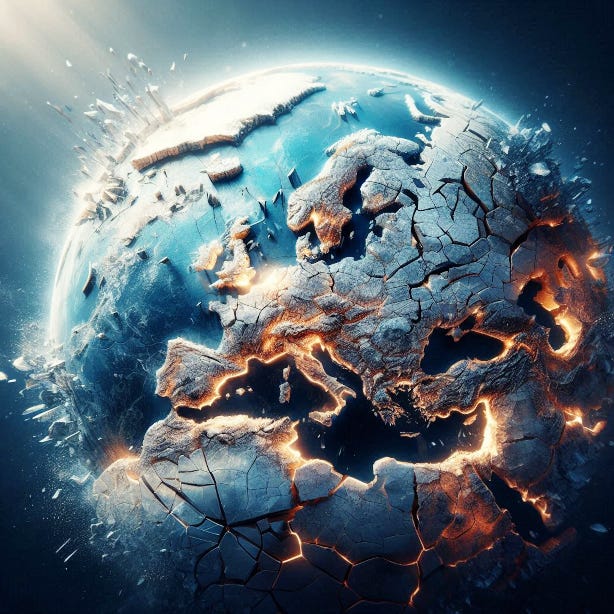
Since it is useful to make one’s predictions concrete, I mean between now and 2050, and more specifically the next 10 years (2026-2036). In fact things could happen faster than that: it’s entirely possible that within 5 years AI will have taken over and either humans will be extinct, or going extinct, or the UK while nominally independent will be powerless as all the power will belong to those who control AI (which won’t be the UK).
My contention is that British politicians don’t realise this, or how urgent things are, because if they did realise this, they would be panicking right now, but they are mostly carrying on as if things are normal. They are not. If politicians realised the dangers they would be executing different policies: since they are not, I conclude that they do not realise the dangers.
Politicians should panic because the world is likely to become very very dangerous over the coming years and decades, for two reasons:
rivalry between states, including trade sanctions and war
the advance of AI, causing instability
Britain is totally not prepared for these dangers and the political class don’t seem to realise how serious and urgent the situation is. This article asks what the dangers are, and then suggests what the UK government could do about them.
The advance of AI
Artificial Intelligence (AI) has become vastly more powerful over the last 10 years, and this will continue.
As AI gets better, it will be able to do more people’s jobs leading to increased unemployment and concentrations of power; this will cause unrest, and probably many people will be converted to extremist ideologies, as they see that mainstream parties are apparently unable to cope with the situation.
AI may have geopolitical consequences. For example if one country has more advanced AI than others, that might make their economy far larger than any rival’s giving them unprecedented power. (Note that it’s possible AI might cause both a large economy and high unemployment, if AI displaces lots of jobs.)
Or they might develop unstoppable automated weapons making them unbeatable in warfare. See for example the slaughterbots video from 2018:
Another way AI might help nations win wars is through advance abilities to hack into opponents’ websites. Anthropic’s Claude Mythos model shows what might be possible:
Researchers who test how AI models handle particular requests or tasks, known as “red-teams”, said in a report Mythos was “strikingly capable at computer security tasks”.
They found the tool could locate dormant bugs lurking in decades-old code and easily exploit them.
Ciaran Martin, former head of the UK’s National Cyber Security Centre, told the BBC earlier this week the claim Mythos could unearth critical vulnerabilities much more quickly than other AI models had “really shaken people”.
If a country had the ability to take over control of an adversary’s computers that would give them a massive advantage in war and espionage.
Another problem is that national leaders may miscalculate about how powerful their AIs are, resulting in two countries fighting a war they both expect to win. But they can’t both be right!
Finally, once AI gets vastly more intelligent than humans, we won’t be able to control it, and if it decides to wipe out humanity there will be nothing we can do.
Rivalry between states
Putin and Trump are the main threats (to the UK) here.
Putin is currently invading Ukraine. This war might end in Russia winning, which would cause Putin to turn his attention to other countries, fir example the Baltic states, or Kazakhstan; thus more war and tension. Alternately, Russia might collapse into competing factions (much as Sudan is done) fighting each other. Some of the factions will be militaristic extremists, which also raises tensions. Then there is the question of Russia’s nuclear stockpile, and whether extremists get their hands on it.
Trump might abandon Europe. This would make an attack on Europe by Putin more likely.
Or Trump might attack a European country (e.g. Denmark, which owns Greenland) or a NATO country such as Canada (which he has threatened to annex) or Turkey (which doesn’t get on with Israel, and Israel may persuade Trump to attack Turkey).
It goes without saying that the USA attacking a NATO county would be the end of NATO (at least in its current form).
China may decide to attack Taiwan. They are more likely to do so if they see that other powers are distracted by their own wars, for example if Europe and the USA are in conflict with each other.
If Trump starts a war in the Middle East, causing China to no longer received oil supplies, that may make China take action to resume thier oil supplies. I will note that Japan entered WW2 because the USA was preventing them from getting oil.
Another possibility is that China may decide to help Russia attack Europe. China has an extensive arms industry and an econmoy 10 times the size of Russia’s so would be able to give them a lot of help if they wanted to.
Or other wars might happen which I haven’t listed. The world is becoming a more warlike, violent place.
Don’t just panic, do something
When one acknowledges the situation is deadly serious, one’s first response might be to panic. But panic on its own achieves nothing. Instead, one must feel the fear, feel the panic, note that emotions are a good servant but a poor master, and use those emotions to create an unshakeable resolve to fix the problems.
So what should the UK do?
It needs to become more powerful, in two ways:
more military strength
alliances
In terms of military strength the emphasis must firstly be on nuclear weapons and their delivery systems, because having the ability to turn an adversary’s cities, data centers and leaders into radioactive cinders commands a certain respect.
To prevent an AI apocalypse it would be very useful to have the ability to nuke every data center in the world, in case negotiations to prevent ASI break down.
The second weapon priority is drones, both battlefield drones and long range ones.
Regarding alliances, the UK should take the initiative in creating an alliance of middle powers. Countries that might join are:
NATO countries, excluding the USA
EU countries
other countries including Ukraine, Australia, Japan, South Korea, and Taiwan
If all these countries joined it would have one third of word GDP, making it larger than the USA and twice as large as China. Other countries might also want to join, making the alliance bigger and more powerful. This produces a network effect where the more countries joining, the more powerful the alliance is, and the more countries that want to join it.
Importantly this alliance should make decisions on a supermajority but not unanimity, because vetoes would doom it to impotence.
Part of the job of the alliance of middle powers would be to negotiate a treaty banning AI above a certain power. This treaty would have to be enforcable on countries that don’t agree it it, which is where nuking the data centers comes in.
Summary
The next 25 years will be the most crucial ever for the human species, because they will decide whether we have a glorious future, a shitty future, or no future at all.
It may be that our species’ epitaph will be:
Humans were clever enough to create artificial superintelligence, but not wise enough not to.
We should all make sure that doesn’t happen.
See also
European Defence Policy: how Europe could rule the world, my earlier essay on a middle power alliance, centered on Europe
How middle powers may prevent the development of artificial superintelligence, by creating a middle power alliance and enforcing restrictions on AI
I repeat that nukes are not necessary to destroy data centers. Conventional explosives would work fine.